

Broach Sharpening
Precision Sharpening Services: Maximize Tool Life & Performance
Are you grappling with frequent broach replacements and escalating tooling costs? Discover how our expert broach sharpening services can extend the life of your valuable tools, improve part quality, and significantly boost your bottom line.
U.S. Broach understand the complex challenges of maintaining peak performance in your broaching operations. That’s why we’ve developed a state-of-the-art sharpening process that not only restores your tools but often improves their original performance, setting new industry standards.
The Hidden Cost of Not Sharpening
Broaching tools represent a significant investment for any manufacturing operation. These precision-engineered cutting tools are designed to create complex shapes and internal features with high accuracy and efficiency. However, like all cutting tools, broaches wear down over time, leading to reduced performance, poor part quality, and increased production costs.
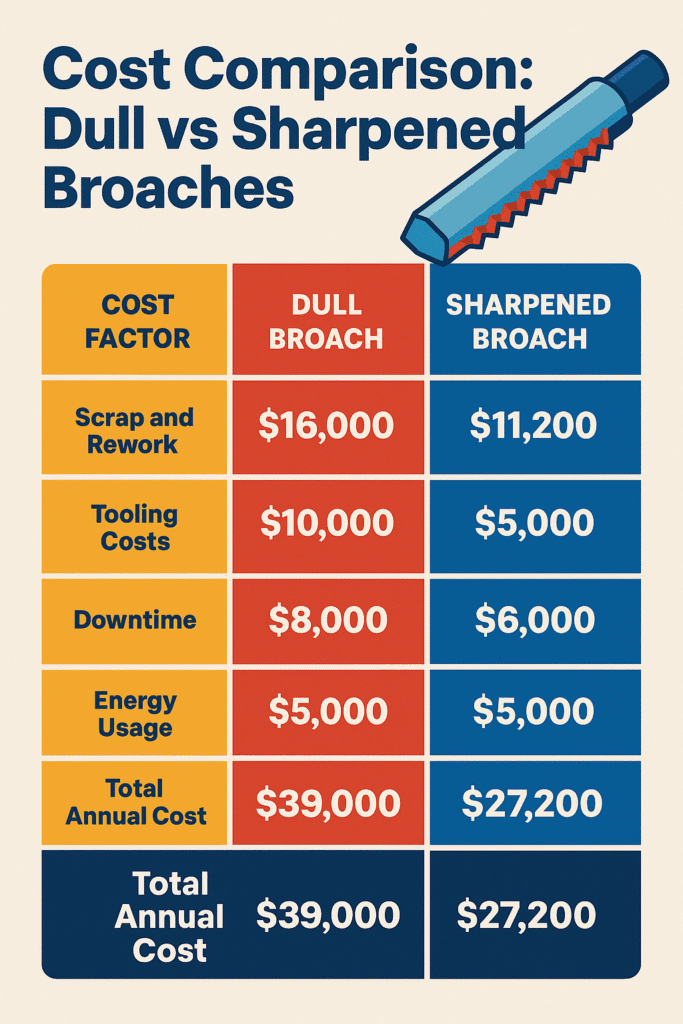
Regular broach sharpening is not just a maintenance task, it’s a strategy for:
- Maintaining part quality and tolerances within micron-level precision
- Reducing scrap rates and rework by up to 30%
- Extending the useful life of expensive tooling by 50-100%
- Improving overall productivity and efficiency by 15-25%
- Reducing tooling costs over time by 20-40%
Implementing regular broach sharpening programs can lead to significant reductions in tooling costs over time, as well as improvements in part quality and production efficiency.
Recommended Broach Sharpening Intervals
| Broach Type | Sharpening Interval | Usage Notes |
|---|---|---|
| Keyway Broaches | Every 2,000–5,000 parts | More frequent in hard metals like stainless or Inconel |
| Spline Broaches | Every 3,000–7,000 parts | Watch for surface finish degradation |
| Surface Broaches | Every 1,500–3,000 parts | Wear appears quickly due to continuous engagement |
| Internal Hex/Round | Every 4,000–8,000 parts | Usually last longer unless cutting abrasive materials |
| Custom/Profile Broaches | Every 1,000–2,000 parts | Profile deviation can occur rapidly in aggressive geometries |
Our Advanced Broach Sharpening Process
At U.S. Broach, we’ve perfected the art and science of broach sharpening through years of experience and substantial investment in cutting-edge technology. Our process goes beyond simple resharpening to deliver tools that often outperform their original specifications.
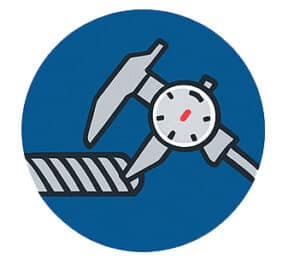
- Inspection and Analysis
Every broach that enters our facility undergoes a thorough inspection using advanced metrology equipment. Our experienced technicians use state-of-the-art measurement tools to assess:
- Tooth geometry and wear patterns with accuracy up to 0.001 mm
- Overall tool condition, including material fatigue and stress points
- Any damage or defects, including microscopic cracks or deformations
This detailed analysis allows us to develop a customized sharpening plan for each tool, ensuring optimal results and extended tool life.
- CNC Precision Sharpening
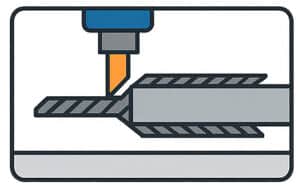
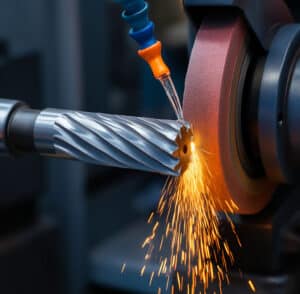
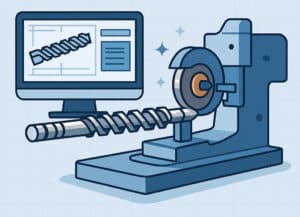
Our state-of-the-art CNC machines are the cornerstone of our sharpening process. These high-precision systems allow us to:
- Restore exact tooth geometry with micron-level accuracy (±0.002 mm)
- Maintain perfect pitch and spacing between teeth (within 0.005 mm)
- Ensure consistent sharpening across the entire tool length (up to 2 meters)
The CNC process guarantees repeatability and precision that surpasses manual sharpening methods—critical for keeping your broach machines running efficiently.
The CNC process guarantees repeatability and precision that surpasses manual sharpening methods, resulting in tools that cut more efficiently and last longer. Our machines are calibrated daily and undergo regular maintenance to ensure consistent performance.
- Surface Finishing
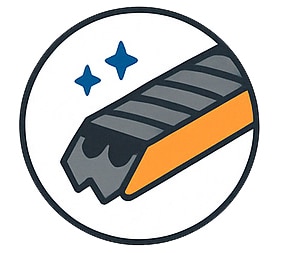
After sharpening, we apply advanced surface finishing techniques to:
- Reduce friction during cutting by up to 40%
- Improve chip evacuation efficiency by 25-30%
- Enhance overall tool performance and longevity
These processes can include:
- Diamond polishing to achieve surface roughness as low as Ra 0.1 μm
- PVD coating application (e.g., TiN, TiCN, TiAlN) to increase hardness and wear resistance
- Cryogenic treatment to improve tool stability and wear resistance
Each surface treatment is tailored to your specific needs and operating conditions, based on factors such as workpiece material, cutting speed, and production volume.
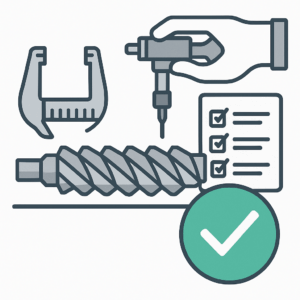
- Quality Control
Before any tool leaves our facility, it undergoes rigorous quality control checks. Our inspection process includes:
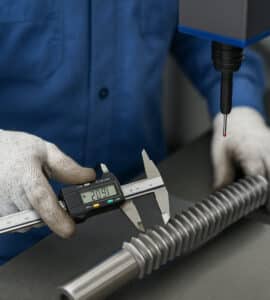
- Precise measurement of tooth geometry using calibrated pins, micrometers, calipers, and other precision tools
- Surface evaluation to ensure proper finish and uniformity
- Dimensional verification against original tool specifications and industry standards (e.g., ANSI B94.55M)
This hands-on process ensures every broach we sharpen meets or exceeds original manufacturer standards. We include a detailed inspection report with each tool, giving you full transparency and confidence in the quality of our work.
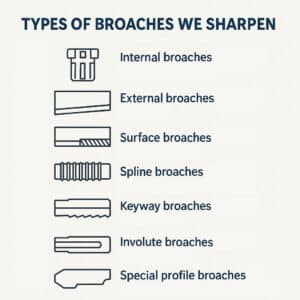
Types of Broaches We Sharpen
Our expertise covers a wide range of broaching tools, including:
- Internal broaches (round, square, hexagonal, spline)
- External broaches (slab, surface, contour)
- Surface broaches (horizontal and vertical)
- Spline broaches (involute, straight-sided, serration)
- Keyway broaches (standard and metric sizes)
- Involute broaches (gear and spline forms)
- Special profile broaches (custom geometries and proprietary designs)
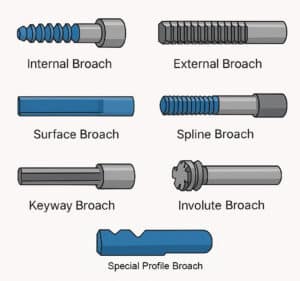
Whether you’re working with standard or custom broaches, our team has the knowledge and equipment to restore your tools to peak performance. We can handle broaches up to 3 meters in length and 500 mm in diameter.
Fast Turnaround and Reliable Service
In manufacturing, downtime costs more than tools. That’s why our turnaround times are among the fastest in the industry.
- Standard service: 3-5 business days
- Rush service: 24-48 hours (subject to availability)
- Emergency service: Same-day turnaround for critical situations (additional fees apply)
Our efficient workflow and dedicated team ensure that your tools are back in your hands and ready for production as quickly as possible, minimizing costly downtime. We maintain a large inventory of replacement parts and consumables to handle unexpected issues without delay.
Frequently Asked Questions
How often should I sharpen my broaches?
The frequency of sharpening depends on various factors, including the material being cut, cutting conditions, and production volume. As a general rule, we recommend inspecting your broaches after every 1,000 to 5,000 parts and sharpening when you notice signs of wear such as increased cutting force, poor surface finish, or out-of-tolerance parts.
For optimal performance and cost-effectiveness, we can help you develop a customized sharpening schedule based on your specific operating conditions and production requirements.
What are the benefits of CNC broach sharpening compared to manual methods?
CNC sharpening offers several advantages:
- Greater precision and consistency across the entire tool (typically ±0.002 mm accuracy)
- Ability to maintain complex tooth geometries accurately, including helical and involute forms
- Faster processing times for quicker turnaround (up to 50% faster than manual methods)
- Repeatable results for consistent tool performance across multiple sharpening cycles
- Advanced in-process measurement and compensation for optimal geometry control
Our CNC machines are equipped with advanced software that allows us to recreate and optimize complex tooth profiles, ensuring that your broaches perform at their best even after multiple sharpenings.
What types of broaches can you sharpen?
We can sharpen virtually all types of broaches, including internal, external, surface, spline, keyway, involute, and special profile broaches. Our equipment and expertise allow us to handle both standard and custom broach designs.
Some specific examples include:
- Keyway broaches from 2mm to 50mm
- Spline broaches up to 500mm in diameter
- Internal broaches up to 3 meters in length
- Custom profile broaches for proprietary part designs
We also offer reconditioning services for severely worn or damaged broaches, including tooth repair and replacement.
What is the typical turnaround time for broach sharpening?
Our standard turnaround time is 3-5 business days. We also offer rush services for urgent needs, with turnaround times as quick as 24-48 hours, subject to availability. For critical situations, we provide same-day emergency service to minimize your downtime.
To ensure the fastest possible turnaround, we recommend scheduling your sharpening services in advance. We offer preventive maintenance programs that include regular pick-up and delivery of your tools to streamline the process.
How does broach sharpening extend tool life?
Broach sharpening extends tool life by:
- Restoring sharp cutting edges, reducing cutting forces and wear by up to 40%
- Maintaining proper tooth geometry for efficient chip formation and evacuation
- Removing damaged or worn material that can lead to premature failure
- Applying surface treatments that enhance wear resistance and reduce friction
Regular sharpening can extend the life of a broach by 2-3 times compared to running the tool until it fails. In some cases, we’ve seen tool life extensions of up to 5 times with proper maintenance and sharpening.
Our advanced sharpening techniques, combined with optional surface treatments like PVD coatings, can significantly enhance the wear resistance and performance of your broaches beyond their original specifications.
Contact Us for a Free Quote and Consultation
Don’t let dull broaches slow down your production or compromise part quality. Our team of experts is ready to assess your needs and provide a tailored solution that will maximize the performance and lifespan of your valuable broaching tools.
We offer:
- Free initial assessment of your current broaching tools
- Detailed cost-benefit analysis of implementing a professional sharpening program
- Customized sharpening and maintenance plans to fit your production schedule
- On-site training for your staff on proper tool handling and maintenance
