

Vertical Broaching Machines
You can’t lead your industry using yesterday’s tools. That’s why more manufacturers are turning to vertical broaching, to do what others can’t, at speeds they didn’t think possible.
At U.S. Broach Machine we have witnessed how vertical broaching technology drives modern manufacturing forward. By delivering unmatched accuracy, speed, and the ability to cut complex internal and external geometries, vertical broaching machines are now essential for industries like aerospace, automotive, tool and die, and defense.
During a recent production audit, a senior manufacturing manager said:
“Implementing vertical broaching reduced our cycle times by over 25%, extended tool life by 30%, and gave us a measurable edge over competitors.”
Across documented case studies, vertical broaching has repeatedly demonstrated significant improvements in production efficiency, waste reduction, and operating cost control.
The shift toward vertical broaching has been so impactful that industry-wide, about 90% of new broaching machine purchases now favor vertical designs. With their space-saving footprint and unmatched one-stroke efficiency, vertical broaching machines are proving indispensable for companies prioritizing precision, speed, and modernized manufacturing workflows.
What Is a Vertical Broaching Machine?
A vertical broaching machine uses a cutting tool called a broach to remove material in a controlled, vertical motion. The broach tool has progressively larger cutting edges that shape slots, keyways, forms, and internal features with extreme precision.
Key features of vertical broaching machines include:
- A vertical stroke, allowing for deep or intricate cuts
- Hydraulic or mechanical actuation for smooth, consistent cutting
- Custom fixturing for stability and accuracy during the broaching process
Our broaching machines are designed and built in alignment with ISO 9001 quality standards and integrate safety requirements per ISO 12100 and OSHA regulations.
Advantages of Vertical Broaching
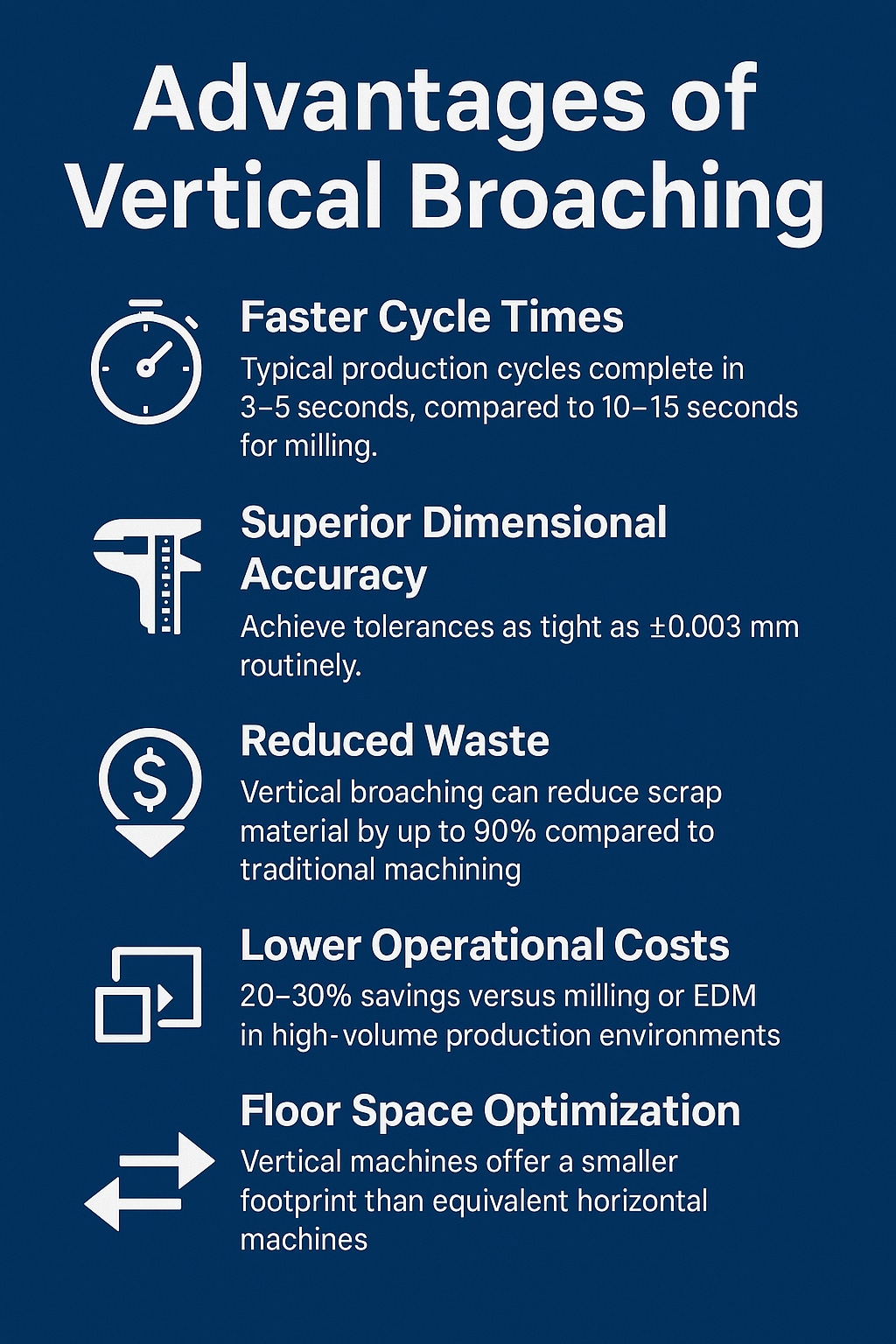
- Faster Cycle Times: Typical production cycles complete in 3–5 seconds, compared to 10–15 seconds for milling.
- Superior Dimensional Accuracy: Achieve tolerances as tight as ±0.003 mm routinely.
- Reduced Waste: Vertical broaching can reduce scrap material by up to 90% compared to traditional machining.
- Lower Operational Costs: 20–30% savings versus milling or EDM in high-volume production environments.
- Floor Space Optimization: Vertical machines offer a smaller footprint than equivalent horizontal machines.
| 📊 Vertical Broaching vs. Milling | ||
|---|---|---|
| Metric | Vertical Broaching 🔻 | Milling |
| ⏱️ Cycle Time | 3–5 seconds | 10–15 seconds |
| 📏 Dimensional Tolerance | ±0.003 mm | ±0.01 mm |
| ♻️ Material Waste | Up to 90% reduction | 40–50% reduction |
| 💰 Operational Cost | 20–30% lower | Baseline reference |
Because vertical broaching combines roughing and finishing in a single motion, companies also benefit from a dramatic reduction in tool changes and secondary machining operations. This consolidation of steps makes vertical broaching one of the few processes that improves both throughput and part quality simultaneously, making it a clear advantage for high-volume manufacturers.
Common Applications for Vertical Broaching
Vertical broaching machines are widely used across industries that demand precision and speed:
- Automotive: Internal splines in gears, connecting rods
- Aerospace: Fir-tree slots in turbine blades, actuator components
- Defense: Rifling inside firearm barrels
- Tool & Die: Cutting keyways and intricate forms in dies and molds
Case Study Highlight: An automotive supplier integrated vertical broaching into their connecting rod line and achieved a 25% cycle time reduction and a 15% increase in dimensional consistency, boosting overall line productivity.
Beyond traditional sectors, vertical broaching has seen growing adoption in renewable energy equipment, heavy off-road machinery, and specialty medical components manufacturing. Wherever durability, precision profiles, and high repeatability are mission-critical, vertical broaching has proven itself as a trusted solution for scalable, high-efficiency production.
Types of Vertical Broaching Machines
Different production goals require different machine designs:
- Pull-Type Vertical Broaching Machines
Pull the broach downward through the workpiece. Best for high-precision internal forms and deep grooves. - Push-Type Vertical Broaching Machines
Push the broach upward through the workpiece. Ideal for external features and shallow cuts. - Continuous Vertical Broaching Machines
For uninterrupted, high-speed production. Common in high-volume automotive and aerospace applications. - Specialty Vertical Broaching Machines
Custom machines for specialized applications like turbine blade slotting and barrel rifling.
In addition to pull and push variations, modern vertical broaching systems often offer hybrid configurations that integrate automated tool changers or quick-swap fixtures, helping manufacturers tackle multiple operations within the same work cell. Some compact table-top vertical models also eliminate the need for a floor pit installation, making them ideal for facilities with space or ceiling height constraints.
Materials for Vertical Broaching
Vertical broaching machines can process a wide range of materials:
- Steel (and hardened steel): Requires coated broaches (TiN, TiAlN) for optimal tool life
- Aluminum and Alloys: Allow faster cycle times due to lower hardness
- Brass and Non-Ferrous Metals: Require specific cutting parameters to avoid deformation
Proper tool coating, cutting speeds, and lubrication strategies are critical for maximizing performance across different materials.
While vertical broaching excels with mid-range hardness materials, specialized broach designs and advanced coatings now allow for selective broaching of higher hardness alloys, provided that cycle times and tool life expectations are carefully managed. Aluminum, for example, can often be broached at accelerated speeds, while high-tensile steels may require custom broach geometries to maintain longevity and performance.
Design Considerations for Broaching
When designing parts for vertical broaching, consider:
- Tolerances: Design for critical tolerances of ±0.003 mm when needed
- Entry Angles: Incorporate lead-in angles (5°–10°) to ease broach entry
- Material Selection: Choose materials compatible with broach tool capabilities
- Cut Depth and Profile: Plan for consistent depth progression to avoid stress concentrations
Collaborate early with U.S. Broach Machine experts to ensure manufacturability and cost-efficiency.
Part designers should also plan for adequate chip evacuation paths when designing broached features, particularly for blind holes or deep grooves. Inadequate clearance for chip escape can lead to broach binding or premature tool wear. Early consultation with broaching specialists can streamline design modifications, ensuring maximum tool life and efficient cutting performance.
Vertical Broaching vs. Other Machining Methods
| 📊 Vertical Broaching vs. Milling vs. EDM | |||
|---|---|---|---|
| 📐 Metric | Vertical Broaching 🔻 | Milling | EDM |
| ⏱️ Cycle Time | 3–5 sec | 10–15 sec | 20+ sec |
| 📏 Tolerance | ±0.003 mm | ±0.01 mm | ±0.005–0.008 mm |
| ♻️ Waste Reduction | Up to 90% | 40–50% | Material dependent |
| ⚡ Energy Consumption | Low | Moderate | High |
For high-volume, precision parts, vertical broaching is the fastest and most cost-effective solution.
Although EDM and milling remain crucial for highly intricate or low-volume parts, vertical broaching outpaces both methods in dedicated production environments. In fact, in many industries, a single vertical broaching machine has been shown to replace multiple mills or shaping machines, reducing not only operational costs but also floor space requirements dramatically.
Maintenance and Troubleshooting
Best practices for maximizing uptime:
- Lubrication: Daily or every 1,000 cycles
- Tool Inspection: Check broach wear every 500 cycles
- Alignment Check: Weekly inspection of guide rails and hydraulic systems
- Vibration Monitoring: Use sensors to detect misalignment early
Following these guidelines can increase uptime by 12% and reduce unplanned downtime by 15%, according to U.S. Broach Machine field data. Learn more about our broach tool sharpening services.
Companies implementing predictive maintenance such as vibration monitoring and real-time hydraulic pressure tracking, report even greater gains in uptime, sometimes exceeding 20% improvements over standard reactive maintenance schedules. Keeping broaching systems finely tuned not only protects production schedules but also maximizes the lifespan of critical machine components and cutting tools.
Safety Considerations
- Mandatory PPE: Safety glasses, cut-resistant gloves, steel-toed boots
- Safety Barriers: Guard moving parts to prevent accidents
- Training: Provide operator certification per OSHA and ISO 12100 standards
- Routine Safety Audits: Conduct monthly inspections to maintain compliance
Newer vertical broaching machines increasingly incorporate light curtain safety systems and two-hand start controls, reducing the likelihood of accidental activation. Regular retraining on safety protocols, combined with proactive maintenance of guards and sensors, creates a working environment where high productivity and operator protection go hand-in-hand.
FAQs: Your Vertical Broaching Questions Answered
When evaluating your machine choice, remember that vertical broaching is best suited for operations where part consistency, production speed, and lower per-piece cost are paramount. Consult with U.S. Broach Machine experts early in the process to design the ideal broaching solution tailored to your production goals.
Q: How fast are vertical broaching cycles?
A: Most high-volume applications achieve 3–5 second cycle times.
Q: Are broaching tools expensive?
A: Upfront cost is higher than milling tools, but ROI is achieved within 6–12 months through lower maintenance and higher throughput.
Q: What coatings are used on broaches?
A: Titanium Nitride (TiN), Titanium Aluminum Nitride (TiAlN), and diamond-like coatings are common.
Q: How do I select the right vertical broaching machine?
A: Selection depends on production volume, material type, stroke length, and part complexity. Contact U.S. Broach Machine for a tailored consultation.
Automation and Integration with CNC Systems
Vertical broaching machines are increasingly being designed with full automation in mind, making them seamless additions to modern CNC-driven production cells. Automated part loaders, robotic arms, and palletized fixturing allow broaching machines to operate as standalone cells or integrate directly into multi-step manufacturing lines.
For instance, a vertical broaching system might automatically load a pre-machined blank, broach a keyway or spline, unload the finished part, and feed it downstream to a CNC machining center—all without operator intervention. This level of integration reduces handling errors, boosts throughput, and ensures consistent cycle times across complex assemblies.
Many newer vertical broaching machines feature CNC-programmable stroke lengths, speeds, and tool changes, allowing operators to quickly adjust for different part numbers or batch sizes. This flexibility is critical for manufacturers adopting just-in-time (JIT) production models or responding to high-mix, low-volume demands without sacrificing broaching’s traditional efficiency advantages.
In today’s competitive market, companies leveraging broaching automation aren’t just keeping up—they’re leading.
Environmental Impact and Energy Efficiency
As sustainability becomes a critical focus across the manufacturing sector, vertical broaching machines are standing out for their energy-efficient performance compared to other machining methods. Unlike EDM or multi-axis milling, which can consume significant amounts of electrical energy over long cycle times, vertical broaching completes most operations in just a few seconds, minimizing machine run-time and energy consumption.
Moreover, servo-driven vertical broaching systems offer even greater environmental benefits. They eliminate the need for large hydraulic systems—traditionally associated with oil leaks, heat generation, and maintenance issues—while reducing standby energy usage by up to 30% compared to conventional hydraulics.
Beyond direct energy savings, the precision and one-pass nature of broaching help reduce scrap rates dramatically, meaning less material waste and lower overall resource consumption. By adopting vertical broaching solutions, manufacturers not only gain a production advantage—they take a proactive step toward greener, leaner manufacturing practices that align with global sustainability goals.
In an industry where every efficiency counts, vertical broaching delivers real, measurable environmental value without compromising on quality or performance.
Transform Your Production with Vertical Broaching
Vertical broaching offers speed, precision, and cost-efficiency unmatched by traditional machining methods. Whether you’re optimizing automotive components, aerospace assemblies, or specialty parts, U.S. Broach Machine delivers the expertise and technology to move your production forward.
